
How to Become a Certified Clinical Research Coordinator

Learn how to become a certified clinical research coordinator with steps, skills, training, and certification to start your career in clinical trials.
Clinical research continues to expand as a core pillar of modern healthcare, and at the center of every well-managed clinical trial is a skilled Clinical Research Coordinator (CRC). Whether you are a student, a life sciences graduate, or a working professional planning a transition, becoming a certified CRC can open the door to structured and long-term career opportunities.This guide provides a complete roadmap, from understanding the role and responsibilities to building the right foundation through training and certification.
Why Choose a Career as a Clinical Research Coordinator?
A career as a CRC offers a unique balance of scientific understanding, operational execution, and patient interaction. Unlike purely academic roles, this position allows you to actively contribute to the development of new treatments and therapies.
Key Reasons to Consider This Career:
- Increasing demand due to global expansion of clinical trials
- Opportunities across hospitals, research sites, and Clinical Research Organization(CROs)
- Exposure to international protocols and regulatory standards
- Stable career path with defined growth opportunities
- Direct involvement in patient safety and study quality
Additional Advantages:
- Opportunity to work on diverse therapeutic areas
- Hands-on exposure to real clinical environments
- Strong foundation for advanced roles like CRA or Trial Manager
- Growing relevance in decentralized and hybrid trials
What Does a Clinical Research Coordinator Do?
Before pursuing certification, it is essential to understand the practical scope of the role. A CRC is responsible for managing and coordinating clinical trials at the site level while ensuring compliance with regulatory standards.
Core Responsibilities:
- Coordinating daily clinical trial operations
- Ensuring compliance with Good Clinical Practice (GCP)
- Managing essential documentation such as:
- Informed Consent Forms (ICF)
- Case Report Forms (CRF)
- Trial Master File (TMF)
- Screening and enrolling eligible participants
- Scheduling subject visits and follow-ups
- Maintaining accurate and audit-ready records
- Acting as a communication bridge between investigators, sponsors, and patients
Extended Responsibilities:
- Handling adverse event reporting
- Supporting monitoring visits and audits
- Ensuring strict protocol adherence
- Coordinating with laboratory and pharmacy teams
Understanding these responsibilities early helps you align your preparation with actual job expectations.
Is CRC Certification for Beginners or Experienced Professionals?
One of the most common questions among aspiring candidates is whether CRC certification is meant for experienced professionals or beginners entering the field.
The answer is both, but with different objectives.
For Beginners:
- Acts as a structured entry point into clinical research
- Builds clarity on real-world responsibilities
- Helps transition from academic knowledge to practical application
- Improves confidence before applying for roles
For Working Professionals:
- Strengthens existing knowledge with structured frameworks
- Helps align practical experience with regulatory expectations
- Supports role transition (e.g., CRC to CRA)
However, in today’s hiring landscape, many organizations expect candidates to have basic awareness of site-level workflows, even at entry level.
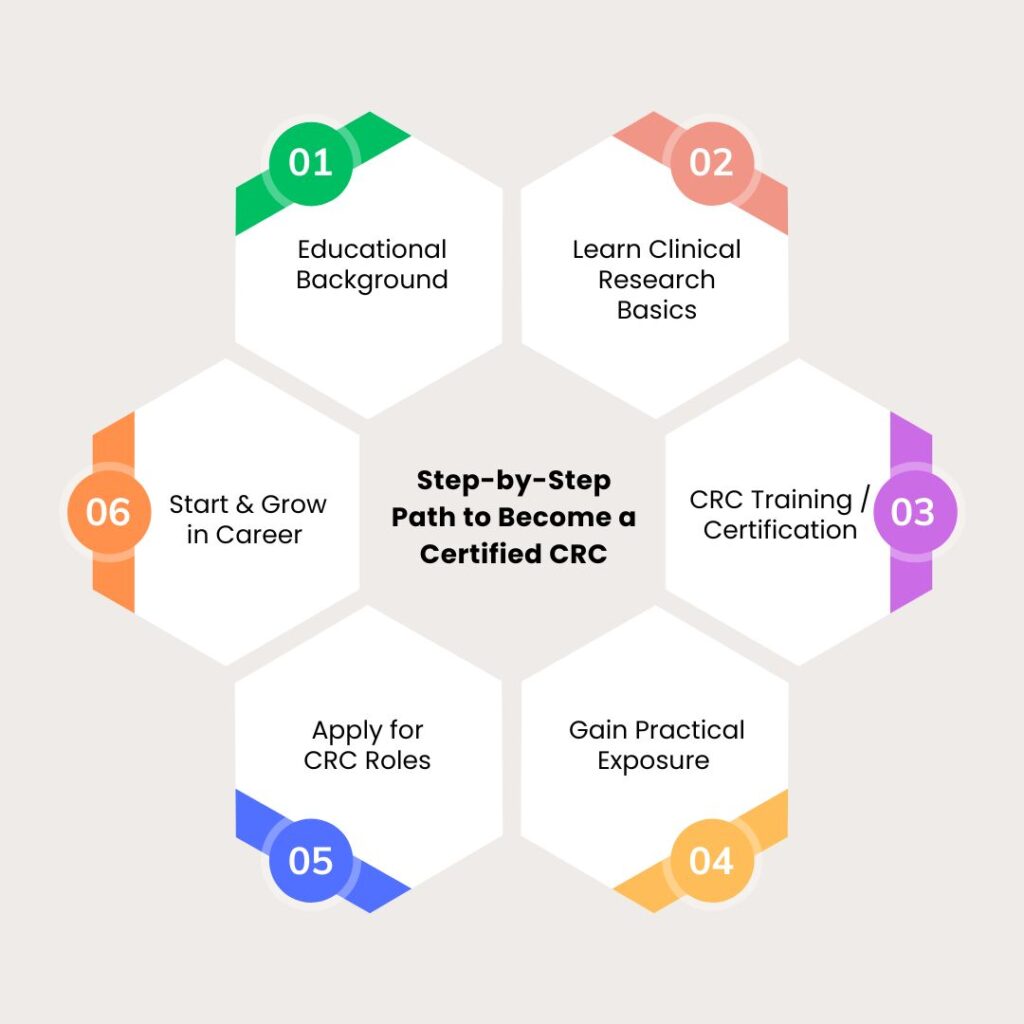
This is why beginner-focused CRC certification programs are increasingly becoming the starting point for individuals entering clinical research.Step-by-Step Path to Become a Certified CRC
Step 1. Build a Relevant Educational Background
Most Clinical Research Coordinators (CRCs) come from science or healthcare-related educational backgrounds. However, the exact pathway can vary slightly depending on the country.
For India:
Common educational qualifications include:
- Life Sciences (B.Sc., M.Sc.)
- Pharmacy (B.Pharm, M.Pharm)
- Nursing or Allied Healthcare
- Biotechnology or Microbiology
- BDS, BHMS, BAMS (in some cases)
These backgrounds provide foundational knowledge in biology, patient care, and medical terminology, which are useful in clinical research.
For USA:
Typical educational requirements include:
- Bachelor’s degree in Life Sciences (Biology, Chemistry, etc.)
- Nursing (BSN or equivalent)
- Public Health or Health Sciences
- Pharmacy or related healthcare fields
In many cases, employers in the USA prefer candidates with:
- A bachelor’s degree as a minimum qualification
- Additional certification or clinical research training
- Some level of healthcare or research exposure
Important Note: Candidates from non-science backgrounds can also enter clinical research through structured training and CRC certification programs, making it a viable option for career switchers. A strong educational foundation, combined with practical understanding, plays a key role in becoming a successful Clinical Research Coordinator.
Step 2. Understand Clinical Research Fundamentals
Before certification, it’s important to develop clarity on how clinical trials function.
Key Areas to Focus On:
- Clinical trial phases (Phase I–IV)
- Study protocols and their structure
- Ethical guidelines and patient safety
- Regulatory frameworks (GCP, ICH guidelines)
- Roles and responsibilities in a clinical trial
This foundational knowledge helps you understand the bigger picture of clinical operations.
Step 3. Enroll in a Beginner-Level CRC certification Program
This step is often underestimated, but it plays a defining role in becoming job-ready.
Academic education provides theoretical understanding, but it does not always cover how clinical trials are executed at the site level.
Why Beginner-Level Certification Matters:
- Bridges the gap between theory and real-world execution
- Provides clarity on day-to-day CRC responsibilities
- Introduces structured documentation practices
- Builds confidence in patient interaction
- Prepares candidates for interviews and job expectations
What a Structured CRC Certification Typically Covers:
- Site-level clinical trial workflows
- Study protocol interpretation
- Documentation such as ICF, CRF, and regulatory binders
- Basics of GCP and compliance
- Patient coordination and visit management
- Real-world case scenarios and applied learning
For candidates without prior exposure, a Certification for CRC often becomes the first step toward understanding how clinical trials operate in real settings.
Rather than being an advanced qualification, it acts as a foundation for entering the industry with clarity and confidence.
Many learning platforms provide this type of certification online in a self-paced format at an affordable price, such as the Clinical Research Coordinator Certification by ProRelix Education.
View Course:https://prorelixeducation.com/courses-page/clinical-research-coordinator-certification/
Certification vs. Non-Certification: What’s the Difference?
| Aspect | Without Certification | With CRC Certification |
| Industry Knowledge | Basic theoretical understanding | Practical, application-based knowledge |
| Job Readiness | Limited | High |
| Confidence in Handling Trials | Low to moderate | Strong |
| Understanding of Documentation | Minimal | Detailed and structured |
| Interview Performance | Average | More confident and structured |
| Career Growth Opportunities | Slower | Faster and more stable |
Step 4. Apply for CRC Roles (If you are beginner )
Once trained, you can begin applying for relevant positions.
Common Entry-Level Roles:
- Clinical Research Coordinator (CRC)
- Site Coordinator
- Clinical Trial Assistant (CTA)
- Research Assistant
Tips for Applications:
- Highlight certification and training
- Demonstrate understanding of workflows
- Emphasize attention to detail and compliance knowledge
Skills Required to Become a Successful CRC
Technical knowledge must be supported by strong practical skills.
Core Skills:
- Attention to detail for documentation accuracy
- Communication with patients and stakeholders
- Time management and multitasking
- Understanding of regulatory guidelines
- Problem-solving and adaptability
Additional Skills:
- Basic data management knowledge
- Organizational and coordination ability
- Professional and ethical approach
- Ability to work in structured environments
Step 5. Gain Practical Exposure (Internship or Entry-Level Role)
Practical experience significantly enhances your readiness.
Ways to Gain Exposure:
- Internships at hospitals or clinical research sites
- Entry-level roles like Clinical Trial Assistant (CTA)
- Observing live clinical trial processes
- Assisting in documentation and coordination
Benefits of Practical Exposure:
- Better understanding of real-time workflows
- Increased confidence in handling responsibilities
- Improved communication with stakeholders
- Familiarity with tools and systems used in trials
Beginner vs Professional Certification (Quick Comparison)
| Aspect | Beginner CRC Certification | Professional Certification (ACRP / SOCRA) |
| Purpose | Entry into clinical research | Validation of experience |
| Level | Beginner | Advanced |
| Eligibility | Open to freshers | Requires work experience |
| Focus | Training + job readiness | Competency + industry standards |
| Examples | Certification for CRC (training programs) | CCRC, CCRA, CC |
Step 6: How to Apply for Certified Clinical Research Coordinator
Once you’ve built a strong foundation through education, training, and initial work exposure, the next step is to pursue professional certification that validates your expertise at an advanced level.Unlike beginner-level certification programs, these credentials are designed for individuals who already have hands-on experience in clinical research and want to strengthen their professional credibility.
Advantages to Become Certified Clinical Research Coordinator :
- Demonstrates advanced competency in clinical research
- Enhances credibility with employers and sponsors
- Supports career progression into senior roles
- Aligns your experience with global industry standards
Here are the available certifications for Clinical Research Coordinator with credibility.
1. Association of Clinical Research Professionals (ACRP)
The Association of Clinical Research Professionals (ACRP) offers globally recognized certifications for different clinical research roles:
- CCRC (Certified Clinical Research Coordinator)
- CCRA (Clinical Research Associate)
- CPI (Certified Principal Investigator)
These certifications are widely respected and indicate a strong understanding of clinical trial operations, regulatory compliance, and ethical standards.
Visit: https://acrpnet.org/
2. Society of Clinical Research Associates (SOCRA)
The Society of Clinical Research Associates (SOCRA) offers:
- CCRP (Certified Clinical Research Professional)
This certification is recognized across pharmaceutical companies, research hospitals, and CROs, and is suitable for professionals involved in various aspects of clinical research.
Visit: https://www.socra.org/
Important Note on Eligibility
Most professional certifications such as ACRP and SOCRA require:
- Prior work experience in clinical research
- Understanding of clinical trial processes
- Eligibility criteria based on role and experience
Certification Bodies, Process & Requirements (Detailed Overview)
| Organization | Certification | Process | Training Requirement | Exam Details | Outcome |
| ACRP (Association of Clinical Research Professionals) | CCRC (Clinical Research Coordinator), CCRA (Clinical Research Associate), CPI (Certified Principal Investigator) | Apply after meeting eligibility → Submit application → Get approval → Schedule exam | No mandatory training, but strong practical experience and knowledge of GCP, protocols, and clinical operations required | Computer-based exam with multiple-choice questions focused on clinical trial operations, ethics, and regulations | Globally recognized certification demonstrating advanced competency in specific roles |
| SOCRA (Society of Clinical Research Associates) | CCRP (Certified Clinical Research Professional) | Meet eligibility criteria → Apply → Schedule exam → Qualify exam | No compulsory training, but understanding of clinical research processes and work experience required | Standardized exam covering GCP, regulations, trial management, and ethics | Widely accepted certification across CROs, hospitals, and pharma companies |
| Training-Based CRC Certification Programs (Beginner Level) | Certification for CRC (Entry-Level Programs) | Enroll in course → Complete modules → Assessments (if applicable) → Certification awarded | Structured beginner-level training covering fundamentals, documentation, and site workflows | Usually includes internal assessments, assignments, or quizzes (varies by platform) | Builds foundational knowledge and job readiness for entering clinical research |
Career Growth After Becoming a CRC
A CRC role offers strong long-term career progression.
Career Path Options:
- Senior Clinical Research Coordinator
- Clinical Research Associate (CRA)
- Clinical Trial Manager
- Clinical Operations Specialist
- Project Manager
Becoming a certified Clinical Research Coordinator is not just about earning a credential, it is about building the ability to handle responsibilities that directly impact clinical trial quality and patient safety
FAQs
A certified Clinical Research Coordinator is a trained professional who manages clinical trials, including patient coordination, documentation, and compliance.
To know how to become a certified Clinical Research Coordinator, complete relevant education, learn basics, get CRC certification, and gain practical exposure.
Is CRC certification required to become a Clinical Research Coordinator depends on employers, but certification improves job readiness and hiring chances.
Yes, freshers can become a certified Clinical Research Coordinator by completing beginner-level certification and gaining basic clinical research knowledge.
What skills are required to become a Clinical Research Coordinator include attention to detail, communication, time management, and regulatory understanding.

