
If you are interested in starting a rewarding career in clinical research, and career as a Clinical Research Coordinator may be a great place to start. This educational high-demand training will provide you with the basic information and knowledge to competently and ethically execute a clinical trial.
As a CRC, you will be in a very important position for a clinical study’s success, coordinating activities between the sponsors, the investigators, and study participants/subjects while ensuring compliance with Good Clinical Practice (GCP), maintaining accurate study documentation, and providing participant safety. A quality structured CRC course will help you understand the study protocol, training, compliance with the site and sponsor, and informed consent process, along with clinical study data management.
Overview of CRC Course Structure
The Clinical Research Coordinator course aims to build students’ knowledge of the clinical trial process and to develop the practical skills needed to manage studies as a CRC. This course includes purpose, design, and phases of clinical trials, and the roles of various stakeholders: sponsor, CRO, investigator, and ethics committee. Students will then learn about Good Clinical Practices (GCP) guidelines and key regulatory frameworks adopted by organizations such as the FDA, EMA, and DCGI, which ensure clinical trials are conducted ethically and consistently with standards around the world.
A large part of the CRC course is dedicated to its roles and responsibilities, including site management, recruitment of research participants, informed consent, protocol compliance, and essential documentation. Clinical trial documentation and management of data will also be covered, with exposure to tools like Case Report Forms (CRFs), Investigator Site Files (ISFs), and Electronic Data Capture (EDC) systems. There is an emphasis in maintaining data integrity, accuracy, and transparency throughout the course of the study.
The CRC course provides students with the technical expertise, ethical knowledge and background, and hands-on experience necessary to competently manage and coordinate clinical trials in hospitals, Clinical Research Organizations, or pharmaceutical companies.
Why Choose a Clinical Research Coordinator Course?
Selecting a Clinical Research Coordinator course can be a beneficial step for students interested in pursuing an education that will lead to a prosperous and rewarding career in clinical research.
1) The need for clinical research coordinators has been rapidly increasing in the Pharma, biotech, and healthcare industries worldwide and in India.
2) This course has been designed according to global clinical research practices so that you can learn in a way applicable to real-life areas of clinical research, and practice.
3) To learn from real-time case studies, preparation of clinical documentation, and clinical trial management processes, so you are prepared when you move on-site and work with a Clinical Research organization.
4) To learn the principles of Good Clinical Practice (GCP) and the international regulations that govern the regulatory processes whenever the research professional is involved in conducting a trial.
5) Many clinical research institutes provide an internship or live project opportunity where students will be able to observe or partake in complex clinical trials. This is a great opportunity for students to gain skills and learn concepts in a hands-on experience.
6) To enter the workforce as a CRC coordinator, clinical trial assistant, or data manager position at the office of a hospital, CRO, or pharmaceutical company.
7) Clinical research is an international industry, and CRC certification will open opportunities for future international employment.
8) As a CRC an integral member of promoting the newest treatment options for patients while ensuring patient safety and adherence to the ethical conduct of research practices, which merges medical science with real-life application.
9) The constant innovations in the field of drug development will allow to establish a career where grow with the need for CRC’s long after the course is completed.
10) By supporting clinical trials that bring new therapies to patients, you are directly involved in bettering patients’ lives as well as global health outcomes.
Key Concepts in Clinical Research Coordinator certification
Becoming a certified Clinical Research Coordinator is an outstanding advancement for students planning a successful career in clinical research. Certification not only confirms a thorough grasp of the subject matter but also verifies that one comprehends the principles that underpin both ethical and effective clinical trials. Here are the key concepts every student must master while preparing for CRC certification:
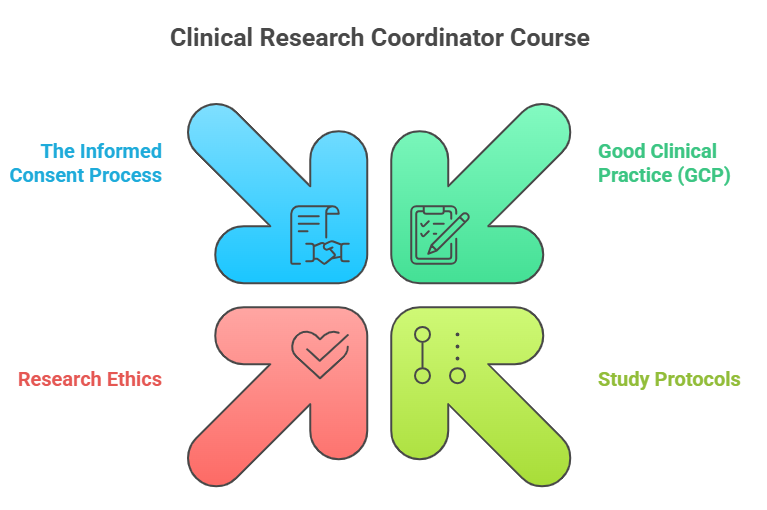
1. Good Clinical Practice (GCP)
GCP is the foundation of clinical research ethics and quality. It is an international ethical and scientific standard for designing, conducting, documenting, and reporting clinical research. For students, GCP means learning how to protect participant safety, ensure scientific integrity, and stay compliant with regulatory requirements.
GCP encompasses important principles such as informed consent, confidentiality, data integrity, and the responsibilities of the investigator.
Training in GCP will assist future coordinators to conduct studies ethically and safeguard the scientific integrity of studies and the results, as well as maintain the overall integrity of the CRO’s.
2. Study Protocols
A protocol is the intricate design of a clinical trial. It outlines the study objective and design, methodology, and statistical aspects.
CRCs are essential to the implementation of and compliance to protocols at the site level for studies.
It should be the goal that students learn to interpret protocol elements (e.g. inclusion/exclusion criteria, dosing schedule, safety monitoring) so that clinical trials are executed as intended.
Also important, not discussed in this handbook, is to understand deviations from the protocol and how to manage them, which is necessary to maintain study integrity.
3. Research Ethics
Ethics are central to clinical research. Students must understand the significance of protecting the rights, safety, and welfare of study participants.
The encompassing ethical principles include Respect for Persons, Beneficence, and Justice, each has been identified in the Belmont Report.
CRCs play an important role in ensuring that all study activities are completed ethically, that vulnerable populations are protected, and that Institutional Review Board (IRB) approvals are obtained before beginning a clinical study.
4. The Informed Consent Process
The informed consent process goes beyond obtaining a signature; it entails educating participants and making sure they are opting into the study voluntarily and with understanding.
Students must know how to explain the components of the study in plain, transparent language, discuss risks and benefits, and answer any participant inquiries.
CRCs also ensure the proper documentation of consent and relay any new information that may affect participants’ potential continued willingness to participate in the study.
Skills Required to Succeed as a CRC Coordinator
- Clinical Research & GCP Knowledge: Knowledge of studying protocols, ethics, and Good Clinical Practice guidelines.
- Organizational Skills: Efficiently manage multiple tasks, schedules, and documentation.
- Communication Skills: Communicate effectively with investigators, sponsors, and study participants.
- Attention to Detail: Ensure the accuracy of data and compliance with the protocol.
- Problem-Solving Ability: Calmly and efficiently manage study issues and protocol deviations.
- Technical Skills: Able to familiarize yourself with EDC systems, CTMS tools, and basic data management software.
- Ethical & Patient Centered: Participant safety is paramount; maintain confidentiality.
- Teamwork: Ability to work well with the clinical research team.
- Adaptability: Keep current with new regulations, technologies, and trial processes.
- Continuous Learning: Participate in training, workshops, and certification programs to develop your skills.
How to Choose the Best Clinical Research Coordinator Course Online for Your Goals
Choosing the right Clinical Research Coordinator online course is a crucial step in providing yourself with the groundwork necessary to become a successful clinical researcher. The demand for skilled CRCs is rising as hospitals, CROs, and pharmaceutical companies work to recruit clinical research professionals. You will want to find a course that aligns with your academic and career goals.
An appropriate CRC course will prepare students to attain both theoretical and applicable skills. Students should begin by identifying their career goals for taking a CRC course, whether students are new graduates with an interest in becoming a clinical research professional, strengthening their understanding of clinical research practices, or transitioning from another discipline. Once you have a clear goal, the next step will be identifying the course provider. You will want to ensure that the institute has a strong reputation and credibility in the industry, and confirm that it has maintained relevant training material current with international regulatory guidance (ICH-GCP, USFDA guidance, EMA, CDSCO).
Another factor to take into consideration is faculty expertise. Courses that are taught by individuals with direct experience in clinical research, pharmacovigilance, or regulatory affairs will give students industry insights that cannot be found in textbooks. Likewise, online learning should be flexible and accommodate all learners. All learning experiences should include recorded lectures, live sessions, mentorship, and access to currently published learning materials so all students can participate in learning when their schedule allows.
Learners should also consider placement assistance, industry value of certification, and previous alumni feedback when embarking on their learning journey. A certificate that is accepted among the leading CRO’s or pharmaceutical organizations will improve employability while validating a clear and thorough understanding of clinical research operational activities. While course fees and duration are factors all individuals should consider, course content relevance and quality should be the only deciding parameters.
The best Clinical Research Coordinator course will develop an understanding of the clinical trial environment, maintain the development of practical skills, and help develop the learner’s confidence to conduct real-world research activity in accordance with good clinical principles. By pursuing a program of quality education, managing regulatory processes within, and focusing on practical learning experience, learners will make a crucial and substantial step towards a subsequent career in a very worthwhile and supportive setting awaiting them within the clinical research field.
List of Top 10 Highly Rated CRC courses
Clinical Research Coordinator (CRC) Course
Advanced Clinical Research Coordinator (CRC) Training
Clinical Research Coordinator (CRC) Basic Training
Clinical Research Coordinator Training Program
Clinical Research Coordinator (CRC) Professional Certification Program
Clinical Research Coordinator I / CRC Certification
Clinical Research Coordinator / Study Coordinator Course
Research Coordinator Training Program
Clinical Research Coordinator (CRC) Course Online
PG Diploma in Clinical Research with CRA/CRC
PGDCR Certification Benefits for the Clinical Research Coordinator CRC Role
The PGDCR (Post Graduate Diploma in Clinical Research) certification offers significant benefits for those aspiring to build a rewarding career as a Clinical Research Coordinator (CRC). It provides a strong foundation in clinical trial design, site management, regulatory guidelines, and ethical research practices. Through comprehensive training in ICH-GCP, regulatory affairs, and clinical data management, this certification equips professionals with the technical and practical skills required to excel in real-world clinical research environments.
Earning a PGDCR certification not only enhances your credibility but also opens diverse career opportunities across Contract Research Organizations (CROs), pharmaceutical companies, biotech firms, and research hospitals. Graduates can begin their careers as a Clinical Research Coordinator (CRC) and gradually advance to roles such as Clinical Research Associate (CRA), Clinical Trial Assistant (CTA), Project Coordinator, Data Manager, Regulatory Affairs Executive, or Pharmacovigilance Associate.
The program also emphasizes practical learning through internships and case-based projects, allowing candidates to gain real-time exposure to trial documentation, site monitoring, and patient management. Moreover, the PGDCR course is globally recognized, helping professionals explore international opportunities in the growing field of clinical research. Overall, the PGDCR certification is a gateway to a successful and impactful career in clinical trials, offering both professional growth and global recognition.
Global Acceptance of CRC Certification
CRC Certifications offered by accredited worldwide clinical research institutes such as ACRP, SOCRA, and ProRelix Education are recognized and accepted globally, including in regions of the world such as North America, Europe, the Middle East, India, and the Asia-Pacific regions. These credentials establish adherence to international standards, including ICH-GCP, which is acknowledged internationally for ethically and quality conducting clinical trials.
For students, CRC certification provides the ability to pursue opportunities internationally, through CROs (Contract Research Organizations), pharmaceutical companies, or research institutions. Employers across the globe prefer hiring certified individuals, as this certification often demonstrates commitment to high standards for research quality and patient safety.
Tips for Networking and clinical research Coordinator jobs
- Begin connecting with professionals during your studies through webinars, LinkedIn, and research forums.
- Join clinical research conferences, workshops, and career fairs to meet recruiters, investigators, and CRCs.
- Become a student member of ACRP, SOCRA, ProRelix Education to access networking events, mentorship programs, and job listings.
- Highlight your education, internships, certifications (like GCP or ICH), and connect with professionals in CROs and hospitals.
- Apply for internships or volunteer positions in research centers to understand study coordination, ethics, and data handling.
- Seek guidance from experienced professionals who can help you with career advice, interview prep, and industry insights.
- Strengthen your communication, organization, and regulatory knowledge. Take online courses in clinical trial management, pharmacovigilance, or regulatory affairs.
- Be ready to discuss topics such as informed consent, patient recruitment, protocol adherence, and clinical documentation.
- Learn about new trends like decentralized trials, eSource, and digital data capture to stay relevant.
- Networking is about relationships—stay in touch, show gratitude, and engage meaningfully with your contacts.
- Employers value students who are passionate, ethical, and eager to contribute to patient safety and research quality.
Is This Course Right for You?
A Clinical Research Coordinator career can be a satisfying and fulfilling career path that combines scientific discovery and patient care. Students who enroll in an organized CRC course will gain the relevant foundational technical, ethical, and practical elements for a career in clinical research. These elements establish a firm foundation in Good Clinical Practice, ethics, and oversight, allowing the CRC to coordinate the clinical study with due diligence and competence.
Whether you work to pursue a job in a hospital, a pharmaceutical organization, or a global CRO organization, a CRC certification gives practitioners new career development pathways and globally recognized career path options. As demand for clinical research practitioners develops, your educational investment is also an investment in building your career. With work and continued educational training focused on patient safety, the role of global health care, and advancing the science of medicine as the CRC, you are uniquely positioned to contribute to advancing health care and the future of medicine.